
Have you ever wondered what, exactly, is behind those unexplained equipment failures, tripped breakers, or the persistent flicker in your overhead lights? For North Bay facilities managers and business owners, those small annoyances rarely resolve themselves. More often, these are early warnings from an electrical system operating under chronic stress. Fortunately, power quality testing is the diagnostic tool that answers the question before it becomes a costly repair, a forced shutdown, or an insurance claim.
What Is Power Quality Testing and Why Does It Matter?
Most facility managers are only able to address what they can see: issues such as aging panels, outdated wiring, and equipment that runs hotter than it should.
Power quality testing goes deeper.
It measures voltage levels, current flow, harmonic distortion, and other factors that affect how efficiently and safely your electrical system operates day to day. Occurring “out of sight”, poor power quality can place constant stress on motors, variable frequency drives, HVAC systems, and sensitive electronics, often shortening service life long before anyone makes the connection.
And for North Bay businesses running manufacturing equipment, medical devices, or data-sensitive operations, that invisible wear carries real consequences.
Power-Related Downtime Is Not Just a Possible – It Is Inevitable
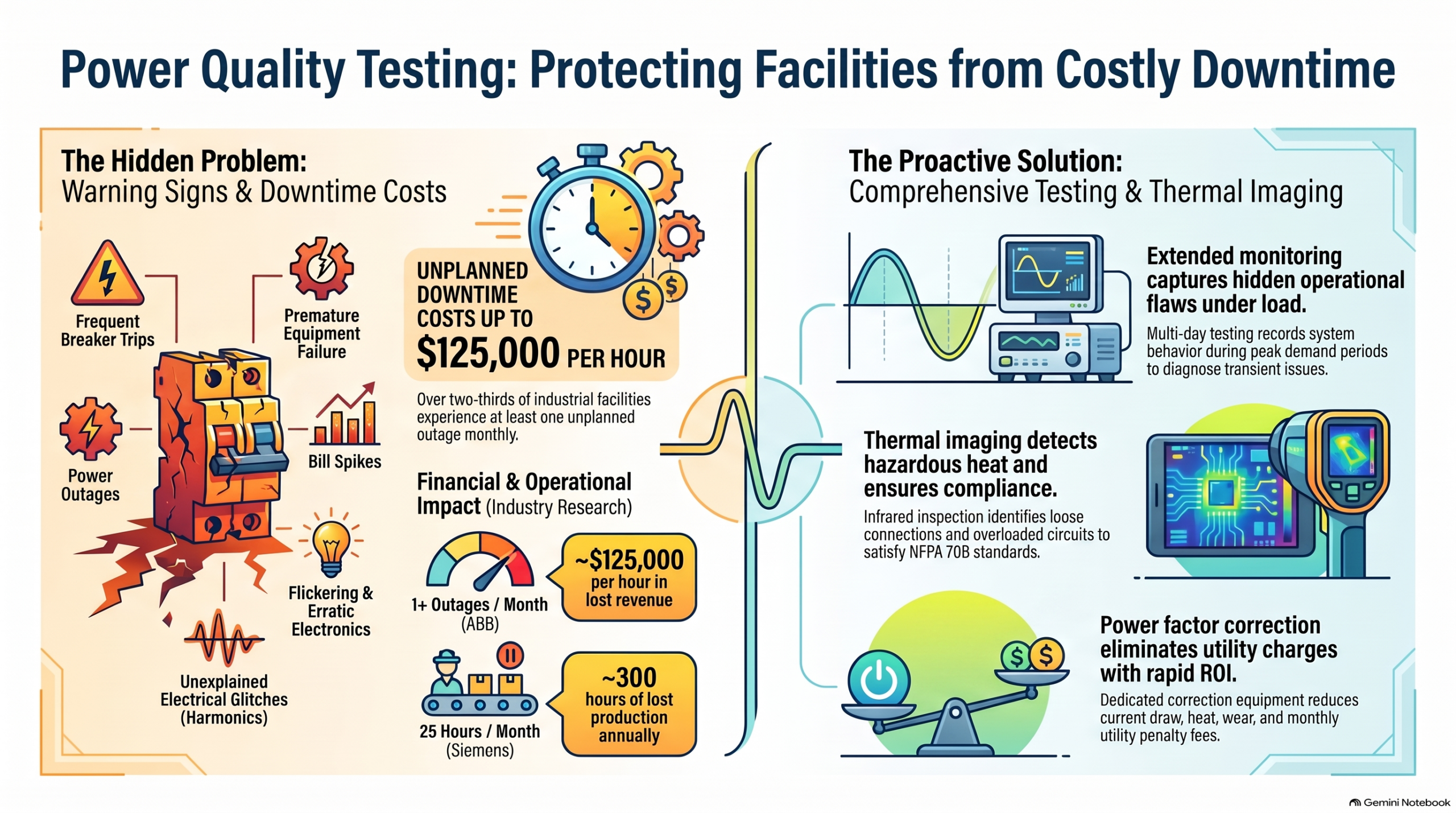
Unplanned downtime is a regular occurrence across industrial operations. In ABB’s 2023 survey, more than two-thirds of industrial businesses reported an unplanned outage at least once a month, with the typical outage costing close to $125,000 per hour.
And in Siemens’ survey of large industrial operations, the average plant lost about 25 hours each month to unplanned downtime. That adds up to roughly 300 hours of lost production time over a year.
Common Signs Your Facility Is Overdue for Testing
Are any of these electrical issues showing up in your facility right now? Some symptoms appear suddenly, while others can be building for months. Here are the warning signs that most often point to a power quality problem:
- Frequent breaker trips with no identifiable overload cause
- Equipment overheating or failing well ahead of its expected service life
- Unexplained spikes in your monthly utility bill
- Flickering or dimming lights, particularly when large equipment cycles on or off
- Electronic equipment behaving erratically or failing repeatedly with no clear cause
Any one of these warrants a call to a qualified electrical contractor. When you’re seeing two or three at the same time, power quality testing has progressed from simply a good idea to a business priority.
Understanding Power Factor and What It Costs You
Most commercial utility bills include a power factor charge, but most business owners have never had it explained.
Power factor measures how efficiently your facility converts electrical power into useful work. A low power factor means your system draws more current than it actually needs, generating excess heat, accelerating wear on equipment. For this reason, many commercial and industrial utility rate schedules include provisions that increase charges when power factor falls below a specified threshold. The exact method varies by utility and rate schedule.
Power factor quality testing identifies exactly where the inefficiency originates. And the solution, which is typically capacitor banks or dedicated power factor correction equipment, often pays for itself within months just through lower utility costs. The good news is that a knowledgeable electrical contractor can assess your facility’s power factor as part of a broader power quality evaluation and recommend targeted solutions with measurable ROI.
What Power Quality Testing Companies Do When They’re On-Site
Hiring the right team matters just as much as doing the testing.
Reputable power quality testing companies deploy specialized monitoring equipment that records your electrical system’s behavior over an extended period, sometimes days or weeks rather than a single visit. It is this time-based data that captures problems which only emerge under load, during peak demand periods, or at specific intervals throughout the day.
In most cases, the testing procedure is paired with an electrical thermal imaging inspection. Infrared cameras detect heat signatures inside panels, switchgear, and connection points that indicate resistance, loose terminations, or circuits operating beyond safe capacity. The findings are documented in a formal electrical thermal imaging inspection report that includes photographs, temperature readings, and a prioritized list of recommended repairs. The result is a clear, defensible record that supports both maintenance planning and insurer requirements.
Building Power Quality Testing Into a Preventive Maintenance Program
Is your current maintenance approach reactive or proactive? For most North Bay facilities, the honest answer is usually “Reactive.” And that’s where costs accumulate. Power quality testing, however, delivers its greatest value when it’s built into a structured electrical preventive maintenance program rather than ordered in response to a crisis.
Regular inspections, scheduled testing, and documented equipment checks identify developing problems before they become an emergency. And the cost of planned electrical maintenance services is a fraction of what an unplanned outage, emergency equipment replacement, or fire-related event would be.
Also, a well-maintained, well-documented program also satisfies NFPA 70B recommendations and keeps your facility in compliance with insurers and code inspectors alike.
The right electrical contractor builds a maintenance schedule around your specific operation by factoring your peak seasons, your most critical systems, and your operational tolerance for downtime. It is that level of customization that separates a mere vendor relationship from a genuine facility partnership.
Schedule Your North Bay Power Quality Assessment
Deferred electrical maintenance is one of the most expensive decisions a facilities manager can make. Electrical systems don’t announce failures. They build toward them gradually and often occur at the worst moment. Power quality testing gives you the visibility to act before a bad day becomes a major event.
If your North Bay facility hasn’t had a formal power quality evaluation in the last three years, or if you’ve recently added load, upgraded equipment, or expanded your footprint, now is the right time to schedule one. Changes to your electrical demand can change the picture entirely.
Knights’ Electric provides power quality testing, thermal imaging inspections, and comprehensive electrical maintenance services for commercial and industrial facilities throughout the North Bay. Contact us today to schedule your assessment.